

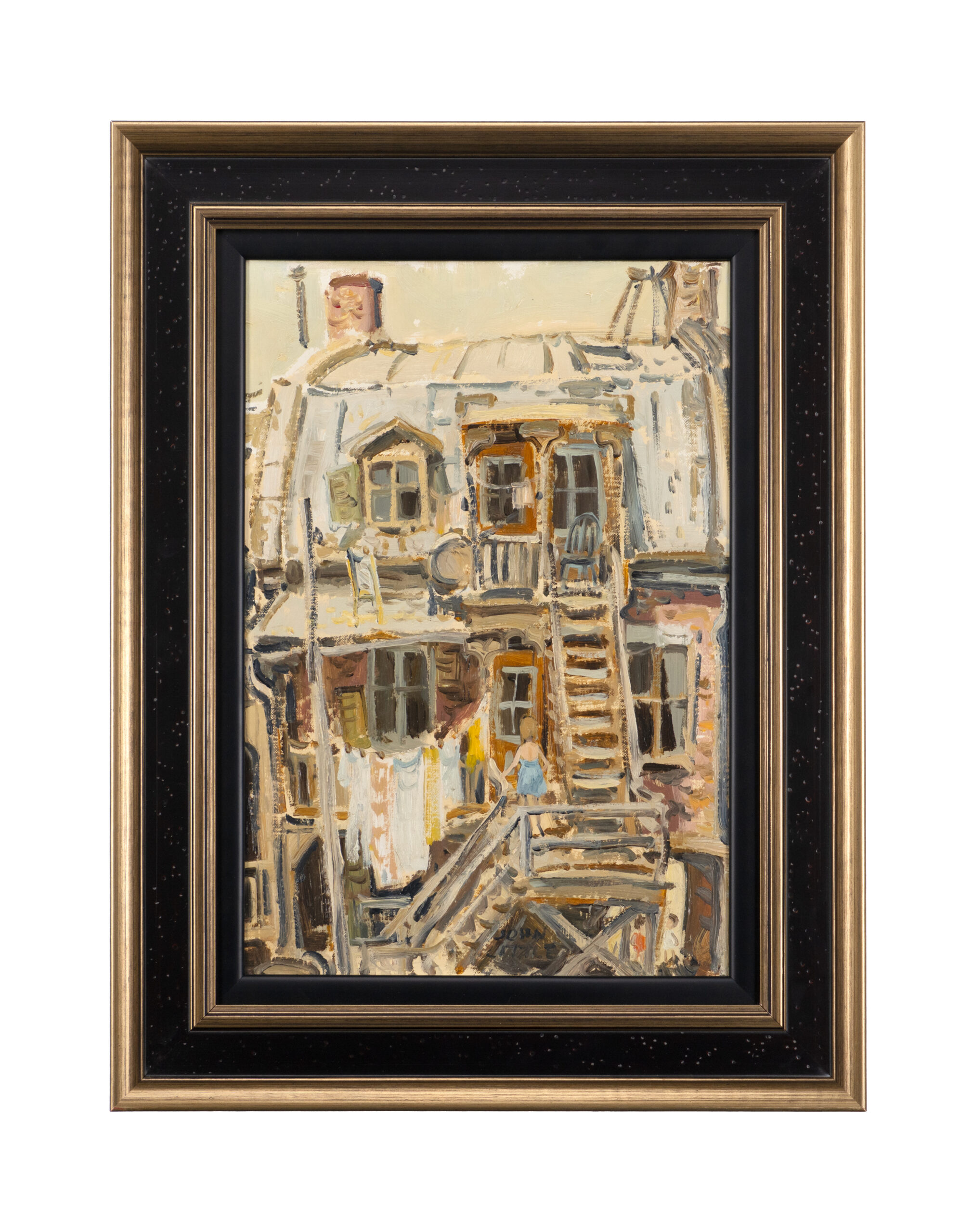
About Little, John
The quintessential urban painter, John Little developed an aesthetic of social and atmospheric realism. His style is characterized by exceptional draftsmanship and a palette often dominated by the muted tones of the Canadian winter. He is famous for his depictions of working-class neighborhoods (such as the Plateau or the “Faubourg à m’lasse”), where he captures the hustle and bustle of the streets: children playing hockey, vintage cars, and brick houses with winding staircases. His brushwork is precise yet lively, successfully rendering the texture of slushy snow on the sidewalk as faithfully as the golden light escaping from a grocery store window.
His artistic philosophy centered on heritage preservation. For Little, painting was an act of resistance against demolition and aggressive urban renewal. He viewed the city as a living organism whose history is inscribed in its vernacular architecture. His philosophy rested on empathy for the everyday: he did not paint monuments, but living environments. By documenting with almost nostalgic fidelity the neighborhoods destined for transformation, he became the guardian of a collective memory, turning every Montreal alleyway into a scene of profound historical and human dignity.
Other works by Little, John
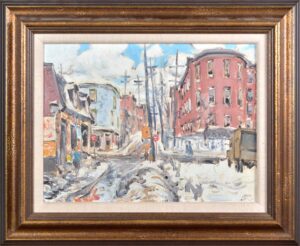
“St-Dominique at La Gauchetière”
Oil on cardboard, signed on lower right John Little, signed, titled and dated on the back Auction result: 25 000 $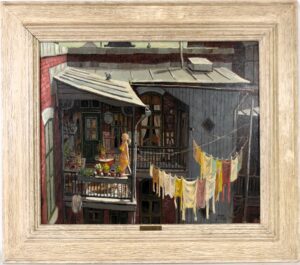
“Summertime”
Oil on canvas signed and dated lower right John Little 54. Auction result: 25 000 $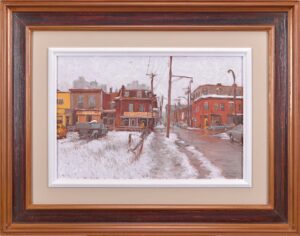
Ontario batteries – formely- Hart batteries, Ontario street Montreal
Oil on canvas, signed on lower right John Little, signed and dated on the back John Little 2011 Auction result: 10 000 $Rejoindre notre infolettre!
Join our newsletter
“Art and love are the same thing: It’s the process of seeing yourself in things that are not you.”
– Chuck Klosterman
Heures d'ouvertures
Lundi au Vendredi
10H00 – 17H00
Samedi et Dimanche
Fermé
Clients
Liens utiles
“Art and love are the same thing: It’s the process of seeing yourself in things that are not you.”
– Chuck Klosterman
Opening hours
Monday to Friday
10:00am – 5:00pm
Saturday and Sunday
Closed