

Do you have a work to sell?
Venard, Claude
1913–1999
Peintre Français, post-cubisme expressionniste
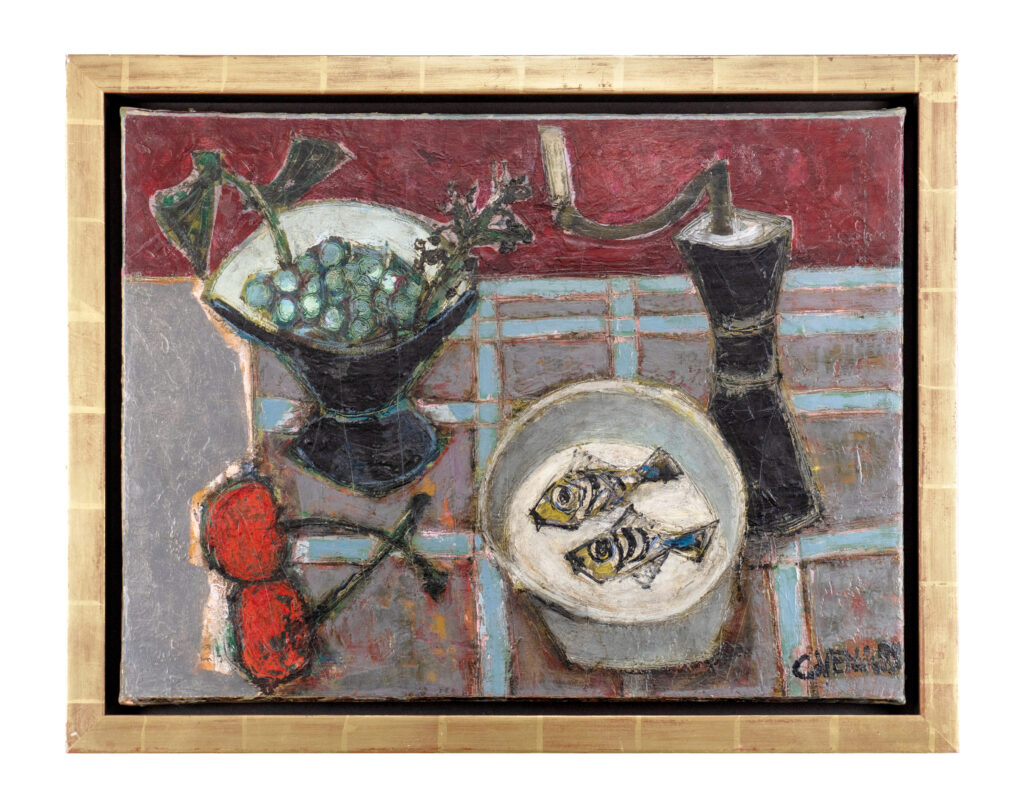
An artist of fiery temperament, Claude Venard developed an aesthetic of expressionistic Post-Cubism. His style is characterized by rigorous geometric compositions, often outlined with thick black lines, which he combined with a generous application of paint using a palette knife. His still lifes, urban landscapes, and portraits reject flat realism in favor of a fragmentation of form reminiscent of the lessons of Braque and Picasso. His palette, initially dark in his early years, transformed over time to embrace rich impastos and bursts of bright, saturated colors, giving his canvases an almost sculptural and stained-glass quality.
His artistic philosophy centered on the pursuit of plastic honesty. For Venard, painting was not meant to imitate nature but rather to assert its own physical and two-dimensional reality. Rebellious against the dogmas of both pure abstraction and academicism, he forged a middle path where everyday objects (a table, a bouquet, a view of Paris) served as a pretext for a celebration of texture and color. His philosophy rested on the idea that a work of art must exist through its internal strength and structure, establishing him as one of the most singular and collected independent painters of the École de Paris.
Best results for Venard, Claude
Rejoindre notre infolettre!
Join our newsletter
“Art and love are the same thing: It’s the process of seeing yourself in things that are not you.”
– Chuck Klosterman
Heures d'ouvertures
Lundi au Vendredi
10H00 – 17H00
Samedi et Dimanche
Fermé
Clients
Liens utiles
“Art and love are the same thing: It’s the process of seeing yourself in things that are not you.”
– Chuck Klosterman
Opening hours
Monday to Friday
10:00am – 5:00pm
Saturday and Sunday
Closed