

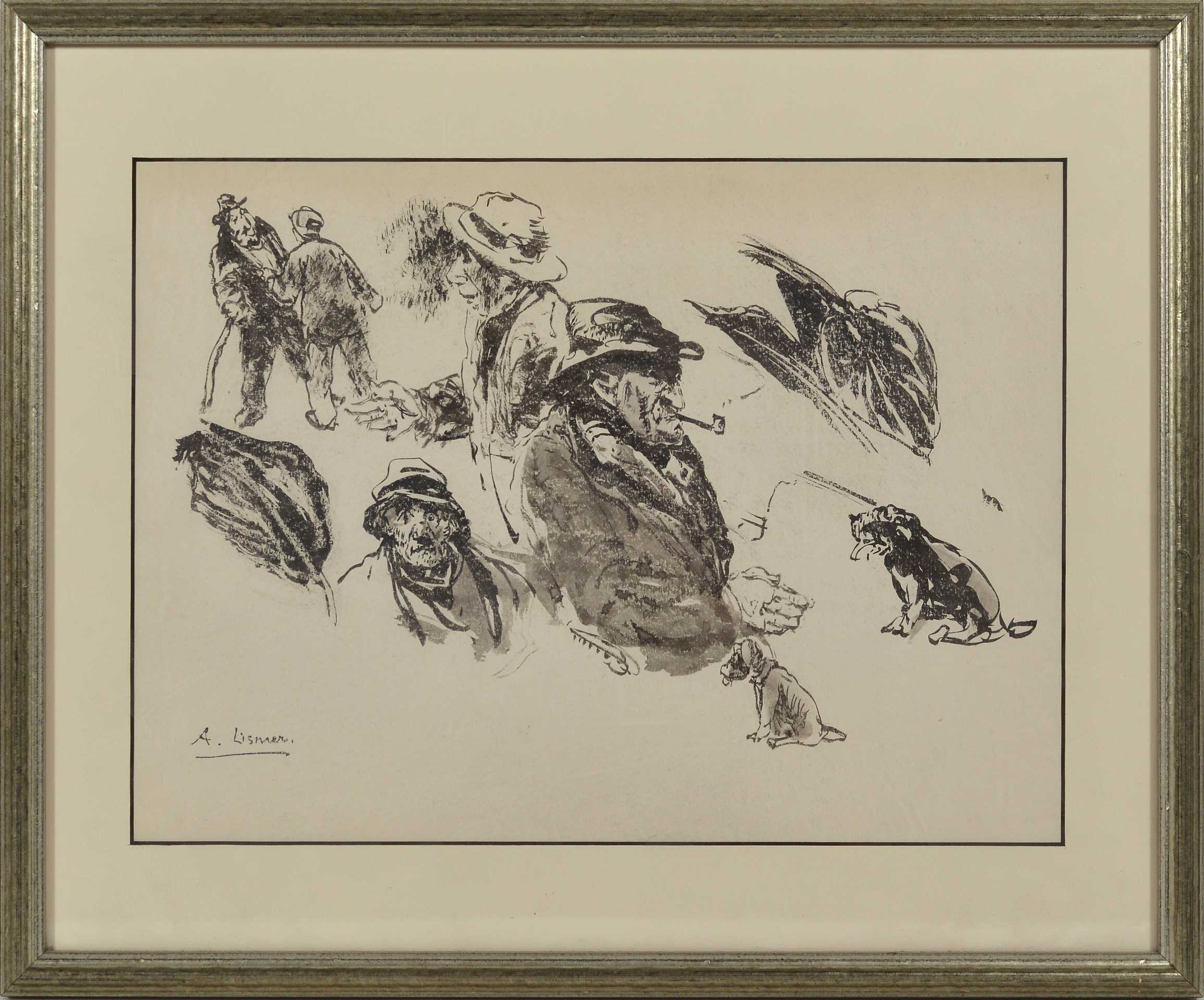
About Lismer, Arthur
Born in England and settled in Toronto in 1911, Arthur Lismer was one of the pillars of the Group of Seven. A field artist and influential educator, he played a pivotal role in the recognition of modern art in Canada, while devoting much of his life to teaching art to children.
Lismer’s thinking was dominated by a fascination with the force of growth and the organized chaos of nature. Unlike Casson’s serenity or Harris’s mysticism, Lismer sought to capture the struggle of the elements. His aesthetic was one of movement, texture, and entanglement, seeing the Canadian forest as a living, dense, and sometimes impenetrable organism.
His paintings of Georgian Bay and Algonquin Park teem with detail—twisted roots, jagged rocks, and wind-swept pines. He used generous impasto and vibrant color contrasts to give his landscapes a sense of depth and vitality. During World War I, he documented camouflaged ships (dazzle painting) in the port of Halifax, an experience that sharpened his sense of pattern and design.
Although associated with the Group of Seven (based in Toronto), he spent the last 28 years of his life in Montreal, becoming a central figure in the local art scene. A Companion of the Order of Canada, his work is celebrated for expressing the magnificent ruggedness of the Canadian landscape with uncompromising honesty. Convinced that art was essential to human development, he founded the Children’s Art Centre at the Montreal Museum of Fine Arts, an institution that has left its mark on generations of Quebecers.
Other works by Lismer, Arthur
Rejoindre notre infolettre!
Join our newsletter
“Art and love are the same thing: It’s the process of seeing yourself in things that are not you.”
– Chuck Klosterman
Heures d'ouvertures
Lundi au Vendredi
10H00 – 17H00
Samedi et Dimanche
Fermé
Clients
Liens utiles
“Art and love are the same thing: It’s the process of seeing yourself in things that are not you.”
– Chuck Klosterman
Opening hours
Monday to Friday
10:00am – 5:00pm
Saturday and Sunday
Closed