

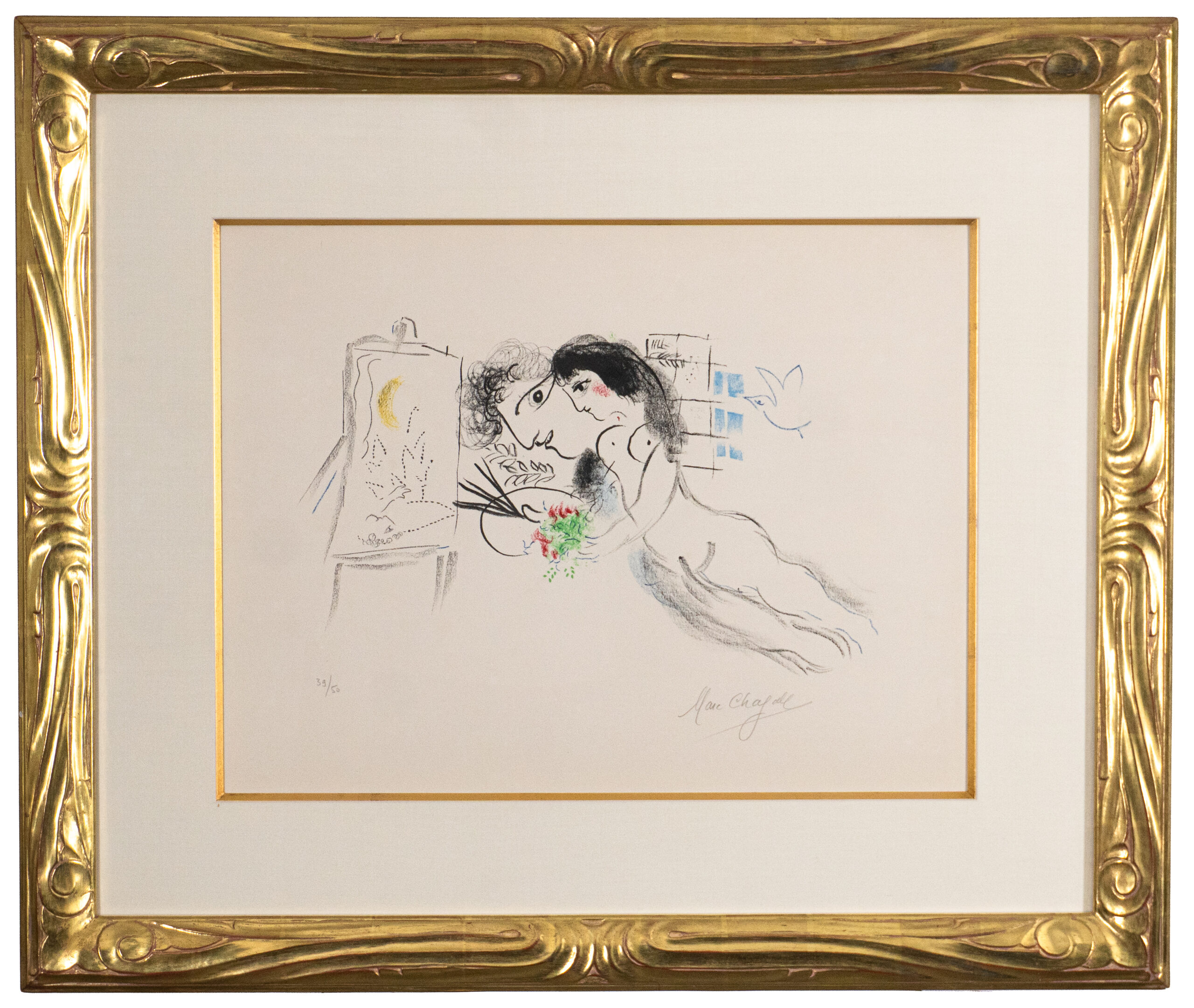
Chagall, Marc (1887-1985)
French artist, Surréalisme poétique
“Rêve familier”
About Chagall, Marc
A Russian-born artist who became a naturalized French citizen, Marc Chagall spanned the century by creating a unique body of work at the intersection of Cubism, Fauvism, and Surrealism. Nicknamed “the painter-poet,” he built a visual universe where dreams, spirituality, and Jewish folklore intertwine to defy the laws of gravity.
Chagall’s aesthetic is rooted in the primacy of emotion and imagination over logic. For him, “art is above all a state of mind.” His thinking rejects rigid labels: he uses the deconstructions of Cubism to serve a dreamlike narrative. He believed in the revolutionary power of love and the Bible, which he considered the greatest source of poetry of all time.
His deep blues and vibrant reds are not descriptive, but serve to convey psychological intensity. Violinists on rooftops, flying donkeys, roosters, and lovers suspended in mid-air compose a personal mythology rooted in his childhood memories of Vitebsk.
Chagall is one of the few artists who managed to reach a wide audience while remaining a major figure of the avant-garde. His work on the Bible redefined sacred art in the 20th century, leading to the creation of his own national museum in Nice.
A witness to two world wars and exile, his work has remained an unwavering hymn to joy and hope.
Other works by Chagall, Marc
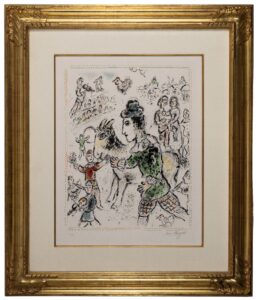
“Clown à la chèvre jaune”
Lithograph on paper, signed lower right Auction result: 13 000 $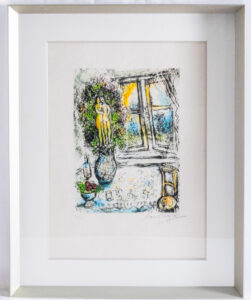
“La fenêtre entrouverte”
Original lithograph on Japon nacré, signed by the artist in pencil lower right Auction result: 6 000 $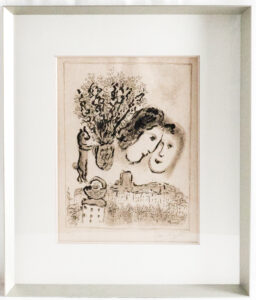
“Double visage gris”
Original lithograph hand-signed in pencil lower right Auction result: 3 800 $Rejoindre notre infolettre!
Join our newsletter
“Art and love are the same thing: It’s the process of seeing yourself in things that are not you.”
– Chuck Klosterman
Heures d'ouvertures
Lundi au Vendredi
10H00 – 17H00
Samedi et Dimanche
Fermé
Clients
Liens utiles
“Art and love are the same thing: It’s the process of seeing yourself in things that are not you.”
– Chuck Klosterman
Opening hours
Monday to Friday
10:00am – 5:00pm
Saturday and Sunday
Closed