

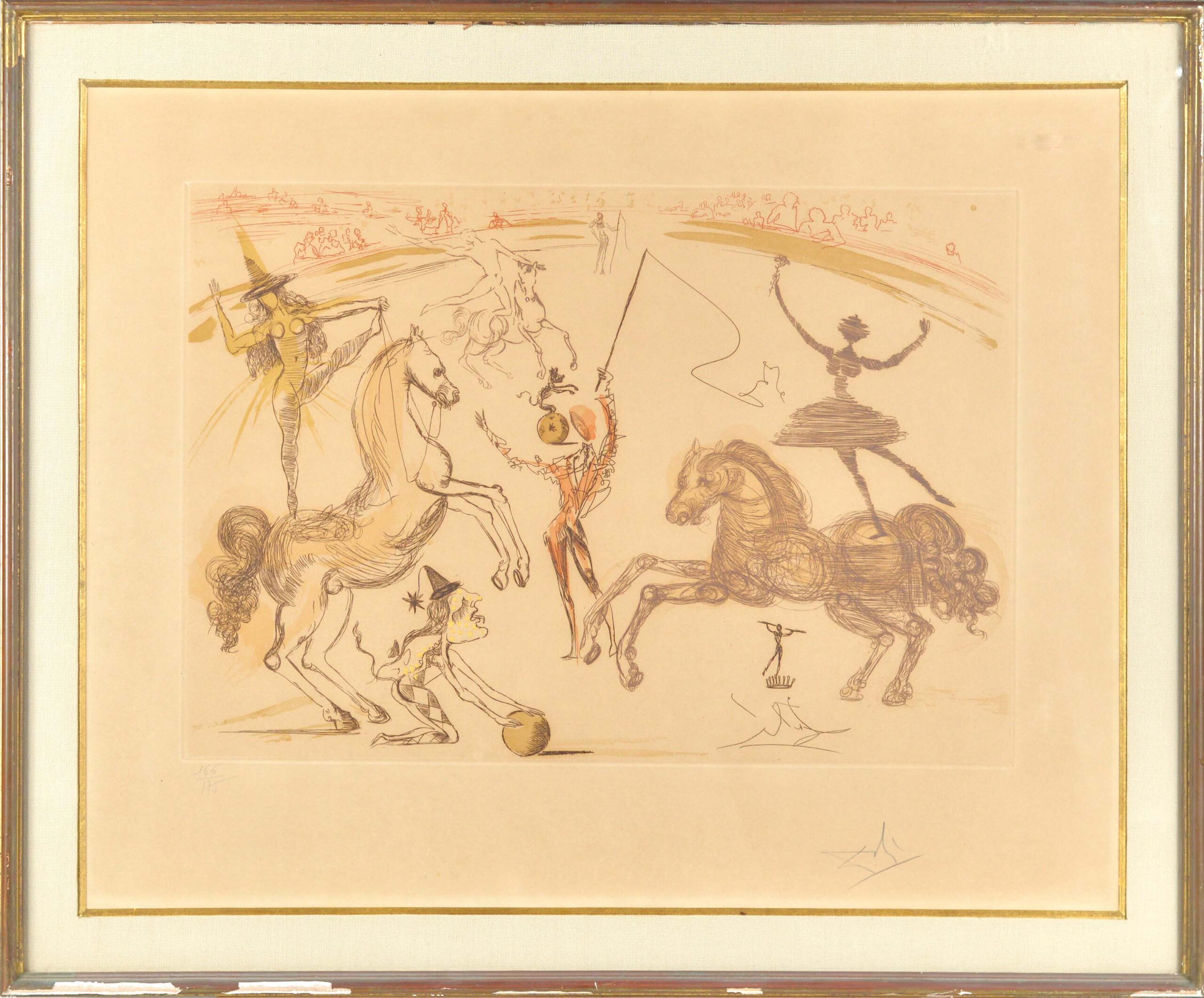
Dalí, Salvador (1904–1989)
Peintre espagnol, surréalisme
Série le Cirque, Écuyère
About Dalí, Salvador
An absolute master of visual illusion, Salvador Dalí developed an aesthetic of figurative Surrealism and the paranoid-critical method. His style is distinguished by a technically rigorous, academic brushwork worthy of High Renaissance masters, which he placed at the service of entirely irrational and dreamlike imagery. He is famous for his barren Catalan landscapes inhabited by impossible objects: melting clocks under a harsh sun, elephants with spindly, arachnid legs, and human bodies propped up by crutches or split open with drawers. His command of perspective, light, and trompe-l’œil allowed him to render dreams and psychological delusions as tangible and real as physical matter.
His artistic philosophy centered on the systematic exploration of the unconscious. Deeply influenced by Sigmund Freud’s psychoanalytic theories, Dalí viewed painting as a vehicle to externalize his deepest obsessions, phobies, and repressed desires. His philosophy rested on his famous “paranoid-critical method”—a creative process involving the simulation of a paranoid state to generate double or multiple reading images, forcing viewers to question their own perception. A theatrical provocateur, Dalí considered his eccentric public persona and lifestyle to be an inseparable extension of his art, establishing him as one of the world’s first true performance artists.
Other works by Dalí, Salvador
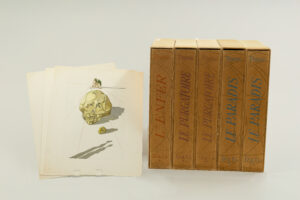
“La Divine comédie”
The Divine Comedy illustrated with 100 wood engravings based on original watercolors by Salvador Dali Auction result: 4 800 $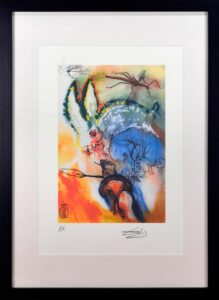
Alice in Wonderland
Rotogravure on paper, E/A, signed on lower right Dali, seal of S. Dali Auction result: 2 000 $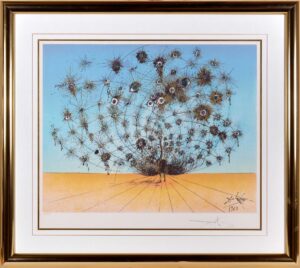
Myth of Argos
Serigraph on paper, 72/350, signed on lower right Dali Auction result: 1 900 $Rejoindre notre infolettre!
Join our newsletter
“Art and love are the same thing: It’s the process of seeing yourself in things that are not you.”
– Chuck Klosterman
Heures d'ouvertures
Lundi au Vendredi
10H00 – 17H00
Samedi et Dimanche
Fermé
Clients
Liens utiles
“Art and love are the same thing: It’s the process of seeing yourself in things that are not you.”
– Chuck Klosterman
Opening hours
Monday to Friday
10:00am – 5:00pm
Saturday and Sunday
Closed